


24.03.2025
In many industries, such as lumber, grain and milling, chemicals and recycling, one of the most serious operational hazards is dust explosions. Dusts that become airborne in the right concentration and in the presence of an ignition source can create explosive atmospheres (ATEX), posing serious risks to people, machinery and infrastructure. For this reason, the identification of explosive atmospheres and the use of appropriate safety systems are today not only a legal requirement, but also a key element of safety management in a manufacturing plant.
What are hazardous areas?
According to the ATEX Directive 1999/92/EC, explosive atmospheres are areas where an explosive atmosphere consisting of a mixture of flammable substances in the form of dust, gas or vapor with air may occur.
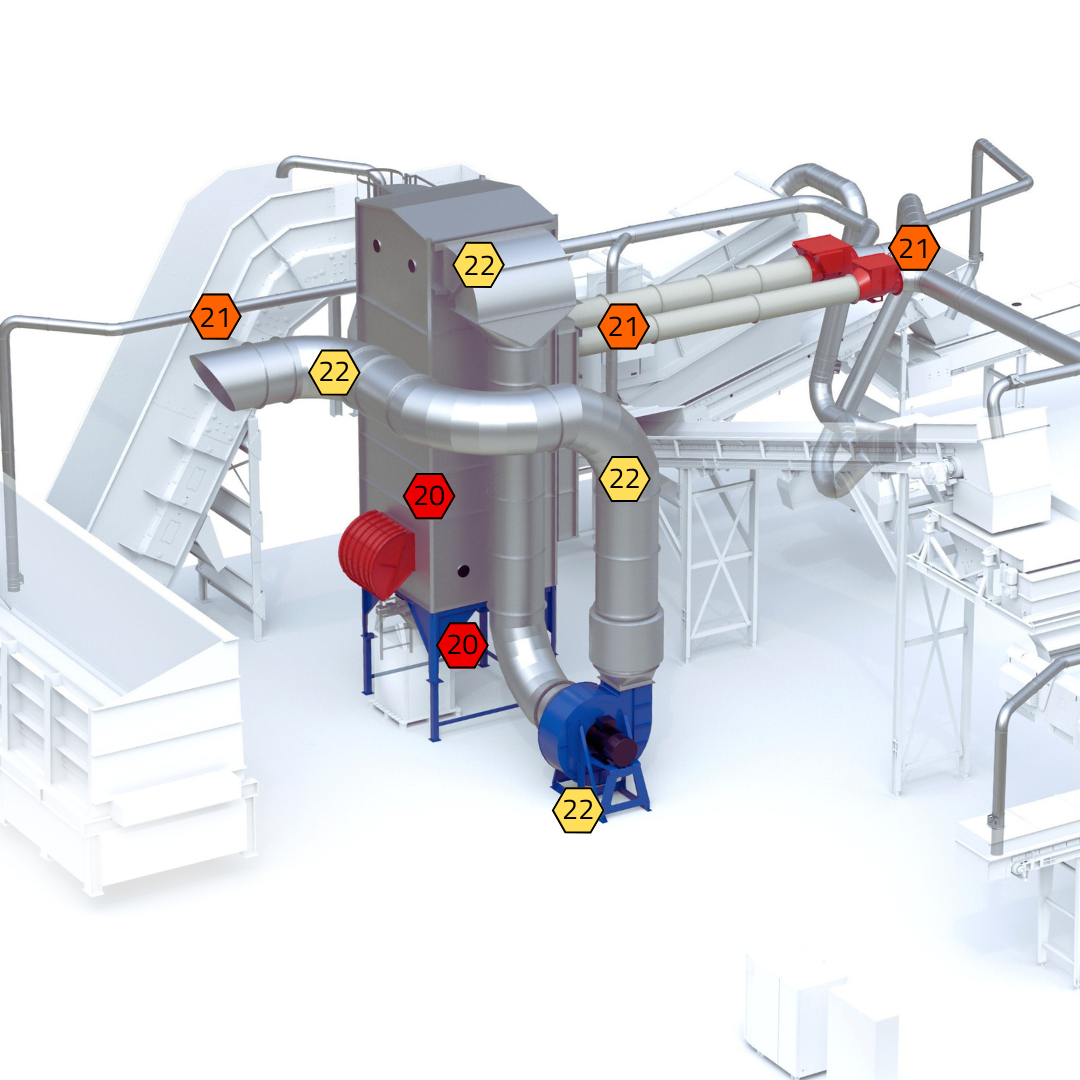
In the case of combustible dust, there are most often three zone classifications:
– Zone 20 – the presence of an explosive atmosphere in the form of dust continuously or for long periods of time.
– Zone 21 – the explosive atmosphere may occur periodically, during normal operation.
– Zone 22 – the explosive atmosphere may occur infrequently and for short periods of time.
Typical locations for such zones are, for example, inside filters, cyclones, silos, dust collection pipelines, and spaces around bulk material loading equipment.
Why do dust collection systems require explosion protection?
When materials such as wood, grain, sugar, coal or aluminum are processed, dusts are produced that, when mixed with air, can be a highly explosive mixture. When combined with an ignition agent, such as a mechanical or electrical spark or even a hot surface, they pose a real danger of explosion.
Dust collection systems that transport and filter air contaminated with dust often operate in conditions conducive to explosive atmospheres. If the system is not adequately protected, the phenomenon of so-called explosion propagation, i.e. the spread of the explosion to further components of the system, can occur.
Prevention and protection in dust collection systems
In order to minimize the risk of explosions, dust collection systems must be designed in accordance with ATEX requirements. This includes both the use of appropriate equipment and the implementation of effective passive and active protection measures.
Most commonly used security measures
– Explosion-proof diaphragms (decompression panels) – allow the safe discharge of excess pressure and flames in a controlled direction (e.g., vertically as in the VFV® NEU-JKF system), preventing secondary explosions.
– Check valves and EX locks prevent the blast wave from reaching other parts of the installation, limiting the spread of the explosion.
– Explosion suppression systems – detect the beginnings of an explosion and immediately neutralize it through the injection of extinguishing agents.
– Spark detection and extinguishing systems – installed in pipelines, detect and extinguish potential ignition sources even before they reach the filter.
– Grounding and electrostatic detection systems – protect equipment from uncontrolled electrostatic discharges.
Designing a safe dust collection system – the role of NEU-JKF
At NEU-JKF, we have been designing and supplying dust collection systems that are ATEX-compliant and customized for years. Our filters, sluices, piping and ventilation systems are certified and suitable for operation in hazardous areas.
Importantly, we also offer unique solutions, such as the VFV® explosion ventilation system, which, unlike standard solutions, directs the blast wave vertically upward (rather than horizontally), increasing the safety of personnel and infrastructure.
Summary
Safety in industrial plants where there is a risk of dust explosion begins with knowledge and awareness. ATEX zones must be clearly defined and dust collection systems properly designed and protected. Implementing proven and certified solutions is not only meeting legal requirements, but more importantly an investment in people’s health, machine durability and production continuity.
Want to learn more about ATEX systems and explosion-proof solutions for dust collection systems?
Contact the experts at NEU-JKF – we can help you design a safe and effective system for your facility.